

He’s found a way to end their war, but will humanity survive to see it?
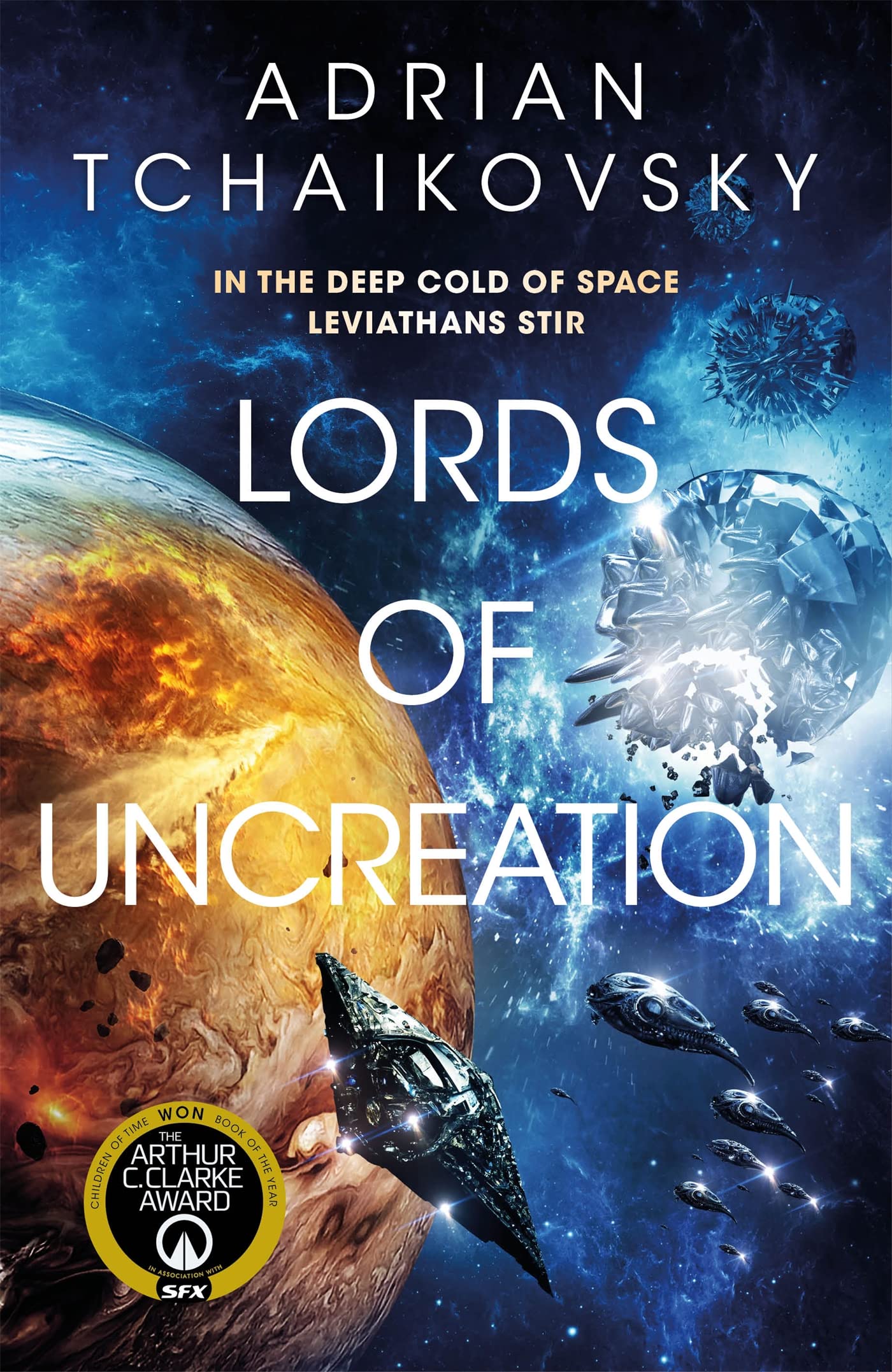
Idris Telemmier has uncovered a secret that changes everything – the Architects’ greatest weakness. A shadowy Cartel scrambles to turn his discovery into a weapon against these alien destroyers of worlds. But between them and victory stands self-interest. The galaxy’s great powers would rather pursue their own agendas than stand together against this shared terror.
Human and inhuman interests wrestle to control Idris’ discovery, as the galaxy erupts into a mutually destructive and self-defeating war. The other great obstacle to striking against their alien threat is Idris himself. He knows that the Architects, despite their power, are merely tools of a higher intelligence.
Deep within unspace, where time moves differently, and reality isn’t quite what it seems, their masters are the true threat. Masters who are just becoming aware of humanity’s daring – and taking steps to exterminate this annoyance forever.

A rewarding conclusion to a great series that plumbs the depths of unspace whilst remaining tethered in the real as well: each of our main Vulture God crew had their specific role to play and came into their powers in a deeply satisfying way.
What I Liked
- The final resolution of the masters behind the Architects
- The way each of our main characters’ skills became vital even if just momentarily
- Olli’s character progression
- Junior!
What Could Have Been Different
- The balance between the real and the unreal didn’t quite feel right for me: there was too much time spent in the unreal
- The first section seemed a little unnecessary – although it was nice to see the Uskaros get their comeuppance!

This will be quick review – and possibly full of typos – because I am writing it on my phone whilst on holiday, piggybacking on the hotel’s wifi!
So the first question is, did I enjoy The Lords of Uncreation? And I definitely did!
Plotwise, Tchaikovsky seems to have scaled things back a little from the first novel where we the reader hurtled from star system to star system. Here, in the final book things seems a little more… stationary, if that makes sense. We do move about the universe that Tchaikovsky created but not to any new planets or systems – instead we delve into the central mystery that has lurked throughout the trilogy: what is Unspace, who dwells there, what is the horrific presence that causes people to kill themselves rather than face it?
Having wrenched The Eye – an alien facility capable of interfacing with Unspace in unique ways – into space in the previous book, Telemmier and his researchers have been installed on another alien vessel The Host under the protection cum control of a strange Cartel held together by Laery the spy Queen and the Hivers. That cartel includes a range of erstwhile antagonists: Aklu, the Hegemonic criminal with whom Olli is working; Hugh under Laery, with whom Havaer Mundy is working; the Parthenon, to whom Solace owes allegiance; the Uskaro family. So our original crew of the Vulture God felt very much dispersed at the start…
When Olli discovers a nefarious plot by (of course) the Uscaru and some within the Parthenon to subvert the Cartel and seize control of The Eye, the plot kicks off and our heroes are isolated, contained and all but imprisoned until a daring rescue plan emerges. And it is a great prison break set piece – with its heroes and its casualties – but in many ways, it felt unnecessary to the central narrative getting us into Unspace for the answers we crave!
In some ways, the delving into Unspace felt not dissimilar to Marvel’s delving into the quantum realm in Antman. How do you convey something beyond human capacity to grasp and to intuit? Tchaikovsky does struggle with that a little – how could any writer not? – but he forced Telemmier and The Eye to require an anchor in real space as they dove into Unspace, a ship to tether them… and whilst the best Parthenon ship had been slated for that, when it was destroyed, there was only one ship that narrative necessity would allow to take that role. So whilst Telemmier, Solace and Kris explored the unimaginable, Oli and Kittering on the Vulture God darted around the Universe dodging Architect attacks with an alien space shark at the controls – I did love Junior!
For me, the practicalities of keeping the ship in one piece and its non-sentient pilot alive and the political machinations Havaer undertook to supply and protect them just about kept the narrative grounded enough – anchored enough – to balance the unreal sections.
And whilst the unreality of Unspace is very much Telemmier’s domain, Tchaikovsky gives both Solace and Kris wonderful moments to shine against the so-called Lords of Uncreation, the Architects’ masters – and ways that played up to and did not overlook their actual skill sets and characters. None of them, however, to my mind, could hold a flame to Oli’s… apotheosis is probably the most apt word here.
Overall, it was clever, balanced and a very well conceived and crafted space opera and an immensely satisfying conclusion to the trilogy.


I have to look up my own review. Apparently the third and final book of the trilogy was forgettable. Because I am really struggling to remember details. The first book was fabulous, I didn‘t enjoy the second…
LikeLiked by 1 person
Here we are… https://cathysreadingbonanza.wordpress.com/2023/05/31/the-real-the-unreal-and-the-unnecessarily-long/
LikeLike