
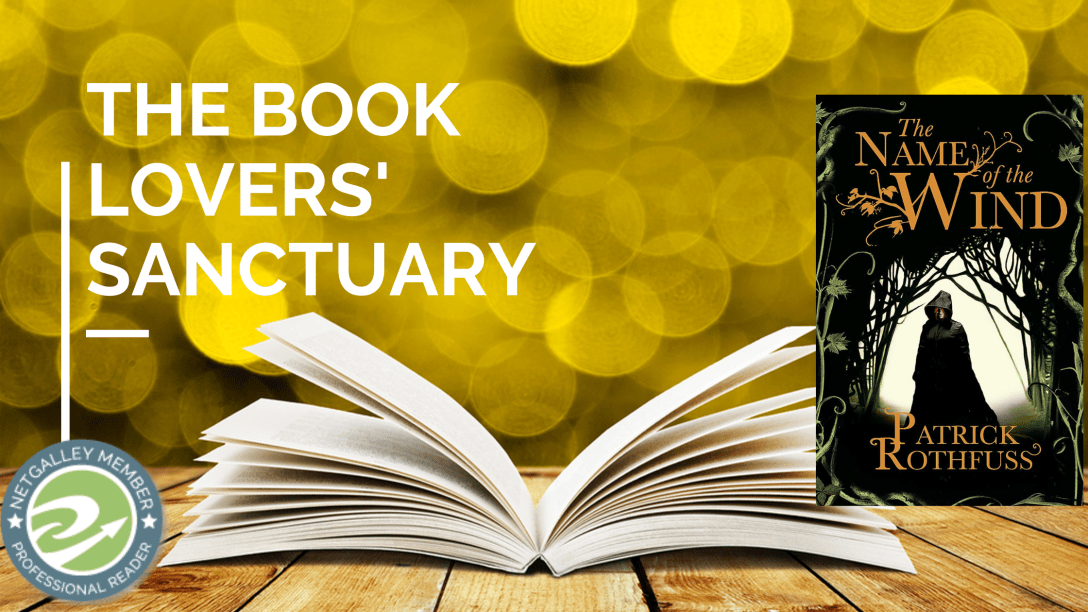

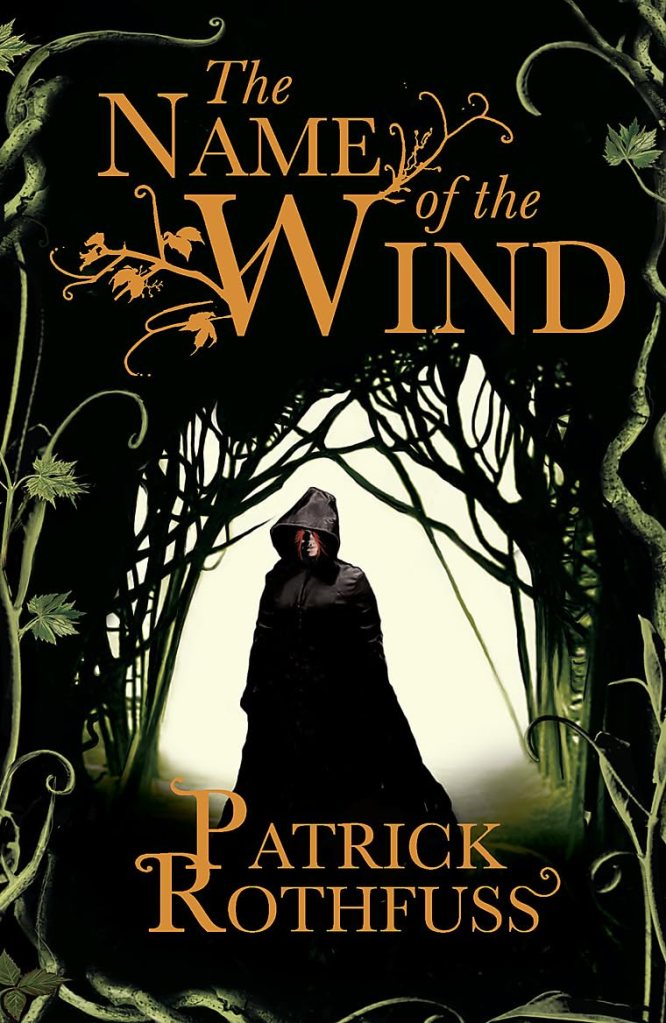
‘‘I have stolen princesses back from sleeping barrow kings. I burned down the town of Trebon. I have spent the night with Felurian and left with both my sanity and my life. I was expelled from the University at a younger age than most people are allowed in. I tread paths by moonlight that others fear to speak of during day. I have talked to Gods, loved women, and written songs that make the minstrels weep.
My name is Kvothe.
You may have heard of me’
So begins the tale of Kvothe – currently known as Kote, the unassuming innkeepter – from his childhood in a troupe of traveling players, through his years spent as a near-feral orphan in a crime-riddled city, to his daringly brazen yet successful bid to enter a difficult and dangerous school of magic. In these pages you will come to know Kvothe the notorious magician, the accomplished thief, the masterful musician, the dragon-slayer, the legend-hunter, the lover, the thief and the infamous assassin.

Whilst this is still, certainly, a masterclass in world building and an intriguing narrative and a great read. However, am I still convinced that this is, as Amazon declares a “lyrical fantasy masterpiece” on a re-read?
What I Liked
- I did enjoy the split narrative: the world in which Kote lives is markedly different from the world in which Kvothe, his alter ego, lived.
- I did like Kote as both character and as narrator
- The world building of Temerant, both in its cities and in its stories and mythologies.
What Could Have Been Different
- Rothfuss presentation of women leaves something to be desired
- Whilst it is well written, some of Kvothe’s experiences seem overly drawn out and a little – dare I say it – self-indulgent?
- Kvothe does come across as somewhat insufferably superior a lot of the time.

Does the first of Patrick Rothfuss’ highly celebrated Kingkiller Cronicles stand up to a re-read? There are many people who say yes… but they are probably the same people who belong to Rothfuss wikis and discussion groups and are busy theorising about who Denna is, who her patron is, who Auri is… They are probably the people who have already given Doors of Stone, the third book, a 3.57 rating on Goodreads before it’s been published!
And why re-read it now? Well, there is a new Kingkiller book coming out from Rothfuss – no, not The Doors of Stone which people have been waiting for since 2011! – but a novella entitled The Narrow Road Between Desire which may focus on Bast…?

Let’s get the plot out of the way first. Kvothe is a child in a travelling troupe of Edema Ruh performers and musicians and, when they pick up a travelling arcanist, is taught some of the magic of the world of Temerant, namely sympathy. When he is away from camp, his entire troupe and family are killed by the mysterious being known as the Chandrian, leaving him an orphan and homeless and he ekes out an existence in the woods with only his father’s lute for company. When the strings break, he travels to the nearest city, Tarbean, where he is attacked by other youths who destroy that lute, which leads to three years alone, traumatised and repressing his experience of his parents’ deaths, destitute on the streets. A tale heard in a bar triggers his recollection and he heads off to the university where he gains admission by being brilliant and by cheating. There are kindly teachers who protect him and take him under their wing; there are bitter and resentful teachers who thwart him. There is Denna. Kvothe manages to eke out an existence always on the verge of being penniless. When he hears tell of a Chandrian attack at a wedding, he absconds from university to investigate, kills a dragon – sort of – and returns to the unlock the ability to call the name of the wind.
It is not a common thing for me to re-read a book and I have to say that I definitely enjoyed it a second time around. I remembered most of what had happened, but there were passages that I had forgotten – Kvothe’s being assaulted in the street for example. And Denna – which is odd as she is a critical character as Kvothe’s main love interest. She seems to be his equal in music and intellect, a simultaneously vulnerable and strong character, with more than a little of the otherworldly about her with tendencies to disappear and reappear and full of secrets.
But the plot as I’ve laid it out doesn’t seem terribly novel, does it? An orphaned boy, seeking revenge after the death of his family, learning – and mastering faster than anyone else could – ancient mystical skills at the hands of a series of mentor figures… it actually feels the embodiment of a fantasy trope rather than a disruption of it. It is Luke Skywalker’s origin story; it is Harry Potter’s origin story… And that’s not to say that it wasn’t well done – it was – and there is not real value to originality in and of itself, but it is not quite the groundbreaking novel that it appears to be.
And the other thing that irked me on a re-read which I hadn’t really spotted last time was the way Rothfuss treats women. Almost all of them are stunning and beautiful to the point that even Bast observes “All the women in your story are beautiful” – or perhaps some are matronly and maternal – and there are very few of them in the novel. They also all seem to be falling over themselves in more or less overt ways, to be with Kvothe who, by the time he is in the university, is fifteen and they are all presumably in their … twenties? We are told repeatedly how extraordinarily young Kvothe is compared to everyone else there which makes the sexual overtures – Devi the moneylender who flirts outrageously, Fela the student who opens the door at one point dressed only in a poorly fitting blanket having slept naked… – rather unsettling. And the comments made by men about women… sometimes downright strange.
But let’s turn to the joy of the novel. I did like the split narrative framing structure. We are told Kvothe’s story by Kvothe himself with lashings of hindsight and narrative comment, because in the present day he is masquerading as the simple innkeeper Kote, recounting his adventures to the historian Chronicler over a series of three nights. I fully appreciated that Rothfuss gave us time to ground ourselves at some length in that ‘present’ world of the innkeep for a significant number of chapters before the backstory commenced. Rothfuss allowed me to invest in that ‘present’, to care for the farmers and blacksmiths that make up this community, to be intrigued by Bast and Chronicler and Kote and the war and the creatures that stalk this world. In many ways, the few days spent in that ‘present’ were certainly as engaging if not in many ways more engaging than the past which can and does at times drag on…
I also adore the storied nature of the worldbuilding here: Temerant, the land created by Rothfuss is rich in its own stories and mythologies, many of which are mere entertainment, some of which are half-remembered and half-mangled children’s rhymes, and some of which are true – terrifyingly and brutally true. The Chandrian attack – it appears – to control and inhibit the passing on of their stories because stories have power; Kvothe mythologises and conjures up his own stories, fully aware of the importance of reputation, and the entire framing narrative is his taking control of his own ‘real’ story; stories create religion and faith, stories sow discord, stories save us from our darkest moments. And stories forge our identity and our sense of self: the story of Kote, wrapped around Kvothe like a cloak, changes who he is…
Many people rave about Rothfuss language as well and it is great writing… but again on a re-read, it is not the best writing in the world. It is a little bit too aware of itself, perhaps – does that even make sense? – and too self consciously calling attention to itself as language. The opening lines for example are
IT WAS NIGHT AGAIN. The Waystone Inn lay in silence, and it was a silence of three parts.
The most obvious part was a hollow, echoing quiet, made by things that were lacking. If there had been a wind it would have sighed through the trees, set the inn’s sign creaking on its hooks, and brushed the silence down the road like trailing autumn leaves..
Inside the Waystone a pair of men huddled at one corner of the bar. They drank with quiet determination, avoiding serious discussions of troubling news. In doing this they added a small, sullen silence to the larger, hollow one…
The third silence was not an easy thing to notice. If you listened for an hour, you might begin to feel it in the wooden floor underfoot and in the rough, splintering barrels behind the bar. It was in the weight of the black stone hearth that held the heat of a long dead fire. It was in the slow back and forth of a white linen cloth rubbing along the grain of the bar. And it was in the hands of the man who stood there, polishing a stretch of mahogany that already gleamed in the lamplight.
It is without doubt an intriguing hook and one of the best openings to a fantasy novel I have read: it sets a mournful and resonant tone that is appropriate for this introduction to Kvothe’s twilight existence. But it feels over crafted to me… not in a way that I feel I can even put a finger on and identify. And another genuinely clunky section went
The evening was too fresh in my memory for me to pay much heed to Deoch’s warning. I smiled, “Deoch, my heart is made of stronger stuff than glass. When she strikes she’ll find it strong as iron-bound brass, or gold and adamant together mixed. Don’t think I am unaware, some startled deer to stand transfixed by hunter’s horns. It’s she who should take care, for when she strikes, my heart will make a sound so beautiful and bright that it can’t help but bring her back to me in winged flight.”
To put this in context, this is a fifteen year old lad, warned off a woman – Denna – by an older respected friend. And this is hard to read as anything other than pompous. It doesn’t fit. It is poetic in the sense of being (broadly) iambic with rhyme… but why? Kvothe is versed in many narratives, songs, ballads, plays and perhaps this moment came from one of them and the pomposity is on account of him quoting – which he does elsewhere – but there is no indication of that in the text.
So, returning to the initial question – was it worth a re-read? Yes, of course! It is a fantastic fantasy novel and of course I hope that Rothfuss is able to complete the trilogy. Is it the best fantasy novel I have read? Glancing at Jonathan Strange and Mr Norrell or The Night Circus or Piranesi… those are judgements you need to make yourselves!


 The Book Lovers' Sanctuary
[…] The Name of the Wind, Patrick Rothfuss […]
LikeLike
Dont support a series thatll never be comoleted please, it wont force him to get the 3rd book out, heck all he has todo is relase 200 pages god forbid
LikeLiked by 1 person
[…] The Name of the Wind, Patrick Rothfuss, 679 pages […]
LikeLike