
I do try to follow a number of book prizes over the year – The Booker Prize, the Women’s Prize, the YOTO Carnegie Medal, the Hugo Award … I find it’s a great way to stumble across new authors and it is through these awards that I have found so many of my now-favourite authors: Maggie O’Farrell, Meg Mason, Bernardino Evaristo, Elif Shafak, Becky Chambers, Arkady Martine.
And this year I am in the unusual position that I have read – or at least begun – all of the shortlisted novels and some of the longlisted novels. I’m not sure how it happened: possibly I had coincidentally read some before either list was announced – certainly I read some via Netgalley; possibly a number of those I chose to read from the longlist were later included in the shortlist… perhaps I neglected my work in order to read more…
But I am in a position to make comment on some of the issues and perhaps rank the novels.

What I did notice was that our narrative voices felt distinctly less millenial than in the past which I enjoyed. Don’t get me wrong, I have nothing against millenial narratives, and many of our narrators were young but there seemed a maturity and an historical depth to those younger characters.
So our narrators – or our point of view characters – ranged from
- childhood and teenage years – Demon Copperhead, The Marriage Portrait
- Teenage / youth – Pod
- Young Adulthood – Fire Rush
- Adult year – Trespasses
- Adult maternal years – Black Butterflies
There was also a preponderance of historical fiction this year as we ranged from
- Renaissance Italy – The Marriage Portrait
- 1970s Ireland and London – Trespasses and Fire Rush
- 1990s Sarajevo – Black Butterflies
- contemporary America – Demon Copperhead
- contemporary oceans – Pod
There also seemed to be a lot of sectarian violence in these novels – what does this reveal about the worries and concerns of the world at the moment? The Northern Irish Troubles, hostilities and violence between white police and black communities – both taking place in the 1970s – and the Serb-Croat violence of the siege of Sarajevo and the ethnic cleansing that took place as part of the Bosnian war in the 1990s all populate these pages. It is not a shortlist for the light hearted.
Anyway, onto my ranking of these novels…
6. Pod, Laline Paull

Ea has always felt like an outsider. She suffers from a type of deafness that means she cannot master the spinning rituals that unite her pod of spinner dolphins. When tragedy strikes her family and Ea feels she is partly to blame, she decides to make the ultimate sacrifice and leave.
As Ea ventures into the vast, she discovers dangers everywhere, from lurking predators to strange objects floating in the water. But just as she is coming to terms with her solitude, a chance encounter with a group of arrogant bottlenoses will irrevocably alter the course of her life.
I’ve got to be honest, this one just wasn’t for me and it’s the only book that I have chosen not finish from the list: I am not keen on animal characters and points of view – I find them really difficult to pull off well and they found their way onto my list of features that put me off reading a book. I’m not going to list it was a DNF and I may come back to it later, but equally I may not…
- Amazon Rating – 4.1
- Goodreads Rating – 3.65
- My Rating – DNF at the moment
3. Trespasses, Louise Kennedy
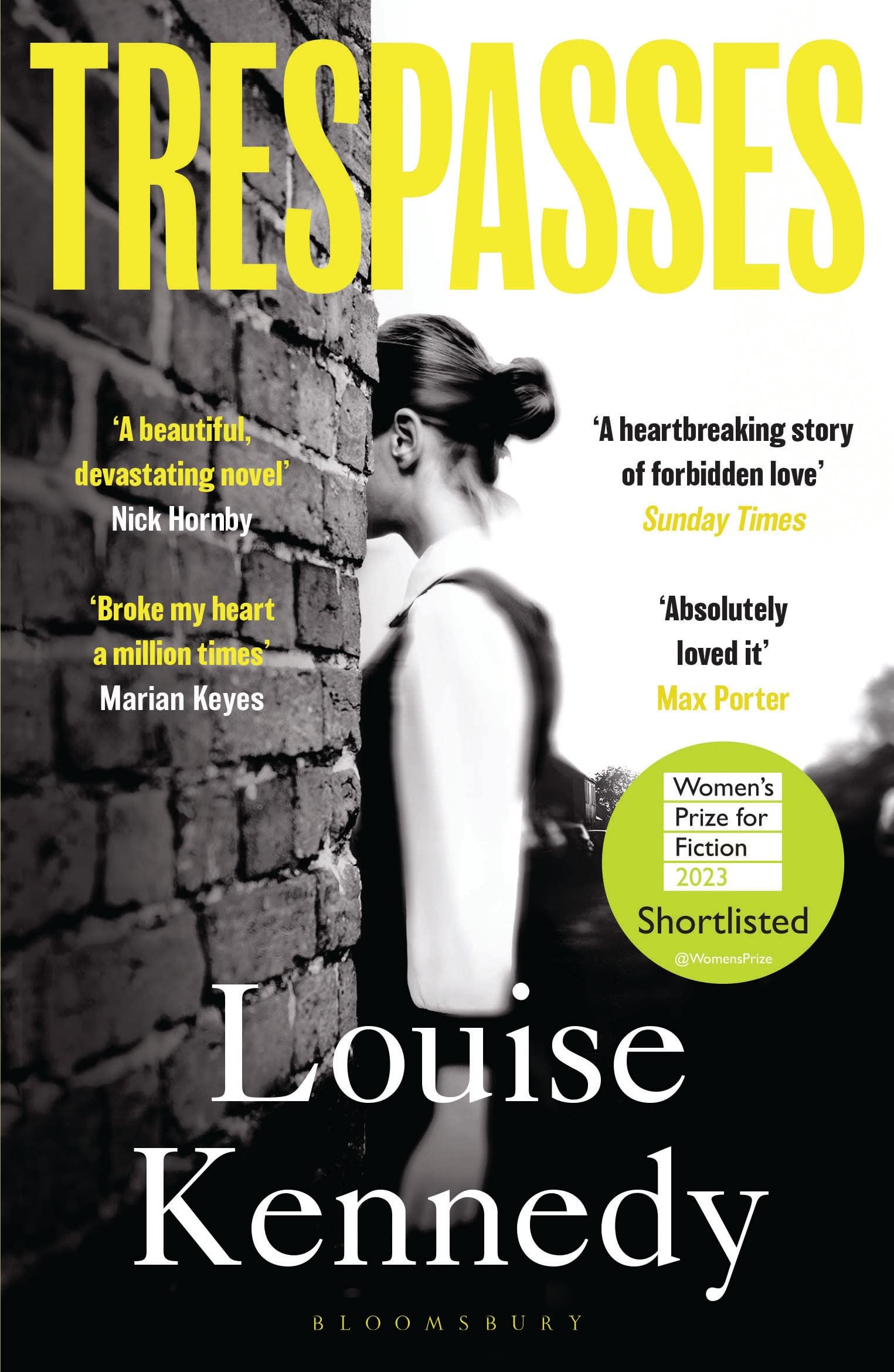
There is nothing special about the day Cushla meets Michael, a married man from Belfast, in the pub owned by her family. But here, love is never far from violence, and this encounter will change both of their lives forever.
As people get up each morning and go to work, school, church or the pub, the daily news rolls in of another car bomb exploded, another man beaten, killed or left for dead. In the class Cushla teaches, the vocabulary of seven-year-old children now includes phrases like ‘petrol bomb’ and ‘rubber bullets’. And as she is forced to tread lines she never thought she would cross, tensions in the town are escalating, threatening to destroy all she is working to hold together.
I enjoyed – is that the right word? – I appreciated and respected the evocation here of the horror of the Troubles in Ireland and the sectarian violence… I was perhaps concerned by Cushla’s lack of agency as a character, and wasn’t sure whether the split focus between the love interest with Michael Agnew and the maternal support for the young boy Davy worked…
- Amazon Rating – 4.3
- Goodreads Rating -4.07
- My Rating – 4.5
4. Black Butterflies, Priscilla Morris

SARAJEVO. SPRING 1992.
Each night, nationalist gangs erect barricades, splitting the diverse city into ethnic enclaves; each morning, the residents – whether Muslim, Croat or Serb – push the makeshift barriers aside.
When violence finally spills over, Zora, an artist and teacher, sends her husband and elderly mother to safety with her daughter in England. Reluctant to believe that hostilities will last more than a handful of weeks, she stays behind while the city falls under siege. As the assault deepens and everything they love is laid to waste, black ashes floating over the rooftops, Zora and her friends are forced to rebuild themselves, over and over. Theirs is a breathtaking story of disintegration, resilience and hope.
I am currently reading this one and really enjoying it – the insistent presence of violence and threat over the city, the moments of horror and of humanity within the most appalling conditions…
- Amazon Rating – 4.6
- Goodreads Rating – 4.34
- My Rating – TBC
3. The Marriage Portrait, Maggie O’Farrell

Winter, 1561. Lucrezia, Duchess of Ferrara, is taken on an unexpected visit to a country villa by her husband, Alfonso. As they sit down to dinner it occurs to Lucrezia that Alfonso has a sinister purpose in bringing her here. He intends to kill her.
Lucrezia is sixteen years old, and has led a sheltered life locked away inside Florence’s grandest palazzo. Here, in this remote villa, she is entirely at the mercy of her increasingly erratic husband.What is Lucrezia to do with this sudden knowledge? What chance does she have against Alfonso, ruler of a province, and a trained soldier? How can she ensure her survival
I loved so much of this but found myself continually comparing it to Hamnet and finding it lacking just some indefinable something – Lucrezia was not quite wild enough, Alfonso was a smiling Janus-faced villain but there was no more depth to him than that. I did love the literary allusion to and echoes of the Browning poem My Last Duchess though.
- Amazon Rating – 4.4
- Goodreads Rating -4.06
- My Rating – 4.5
2. Fire Rush, Jacqueline Crooks

Yamaye lives for the weekend, when she can go raving with her friends at The Crypt, an underground club in the industrial town on the outskirts of London. A young woman unsure of her future, the sound is her guide – a chance to discover who she really is in the rhythms of those smoke-filled nights. In the dance-hall darkness, dub is the music of her soul, her friendships, her ancestry.
But everything changes when she meets Moose, the man she falls deeply in love with, and who offers her the chance of freedom and escape.
When their relationship is brutally cut short, Yamaye goes on a dramatic journey of transformation where past and present collide with explosive consequences.
In a shortlist that felt surprisingly… safe and traditional in many ways, Fire Rush felt like a breath of fresh Caribbean air: the narrative voice is one of the most convincing rhythmic and musical narrative voice that I have come across. And the characters are wonderful, Moose such a gentle and kind and humane character that the violence – and the way Crooks manages that violence – is stunning.
- Amazon Rating – 4.2
- Goodreads Rating – 3.79
- My Rating – TBC
1. Demon Copperhead, Barbara Kingsolver
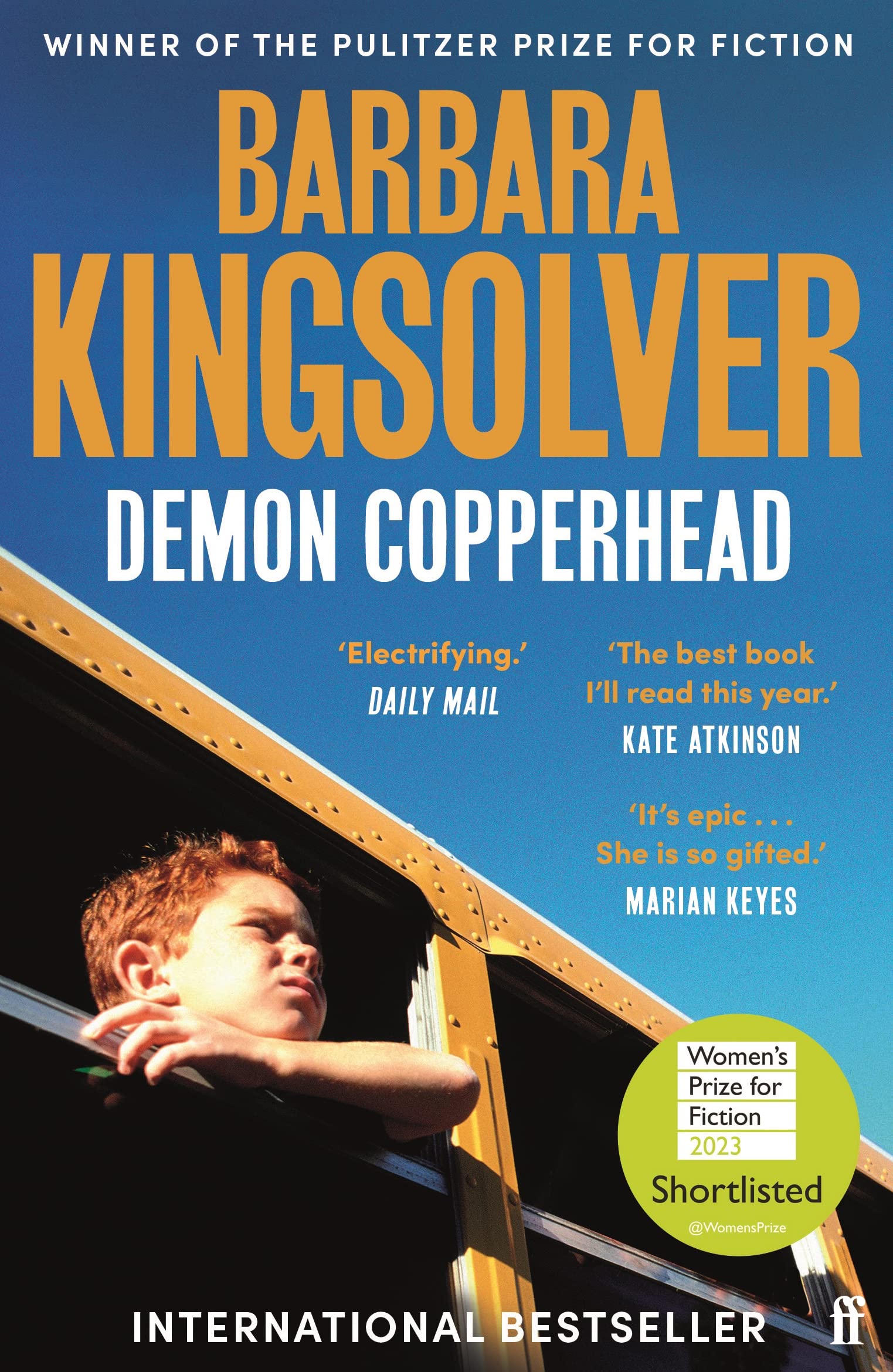
Demon’s story begins with his traumatic birth to a single mother in a single-wide trailer, looking ‘like a little blue prizefighter.’ For the life ahead of him he would need all of that fighting spirit, along with buckets of charm, a quick wit, and some unexpected talents, legal and otherwise.
In the southern Appalachian Mountains of Virginia, poverty isn’t an idea, it’s as natural as the grass grows. For a generation growing up in this world, at the heart of the modern opioid crisis, addiction isn’t an abstraction, it’s neighbours, parents, and friends. ‘Family’ could mean love, or reluctant foster care. For Demon, born on the wrong side of luck, the affection and safety he craves is as remote as the ocean he dreams of seeing one day. The wonder is in how far he’s willing to travel to try and get there.
It would be inconceivable to me if this novel did not win: it is technically a master class in characterisation, in narrative voice, in setting, in structure; it is explicitly literary, as a re-imagining of Dickens’ David Copperfield, but also deeply contemporary. I would not say it is the most enjoyable read on the list – it is in many ways deeply difficult and challenging – but it is without question the winning book in the list.
- Amazon Rating – 4.6
- Goodreads Rating – 4.53
- My Rating – 5
Will my predictions be in any way similar to the judges when they announce the winner tomorrow? Quite possibly not – I do not have a good past record of agreeing with judges on book prizes, but isn’t that the joy of reading that we all have our personal views and opinions and can discuss them?


 The Book Lovers' Sanctuary
[…] I called it last week with my prediction for the Women’s Prize winner 2023 – not that there was any real doubt […]
LikeLike