

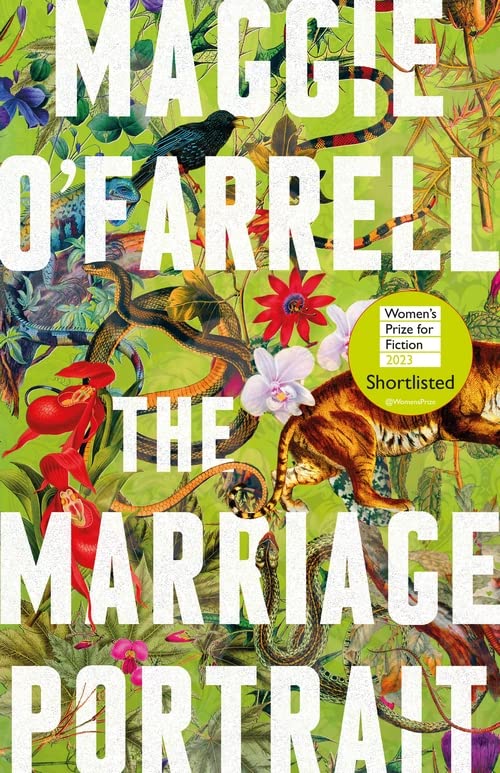
Winter, 1561. Lucrezia, Duchess of Ferrara, is taken on an unexpected visit to a country villa by her husband, Alfonso. As they sit down to dinner it occurs to Lucrezia that Alfonso has a sinister purpose in bringing her here. He intends to kill her.
Lucrezia is sixteen years old, and has led a sheltered life locked away inside Florence’s grandest palazzo. Here, in this remote villa, she is entirely at the mercy of her increasingly erratic husband.
What is Lucrezia to do with this sudden knowledge? What chance does she have against Alfonso, ruler of a province, and a trained soldier? How can she ensure her survival.

A dazzling recreation of Renaissance Italy, described in O’Farrell’s gorgeous prose, this novel again takes a lesser known character from history – Lucrezia di Cosimo di Medici – and breathes life and vibrancy and urgency into their tragic story: just like Hamnet, we know from the opening pages that Lucrezia is destined to die.
What I Liked
- The alternation between the present in the Fortezza in Bondeno as Lucrezia is convinced she will be killed imminently and her upbringing, betrothal and life in Ferrara;
- The detail, depth and liveliness of O’Farrell’s creation of Renaissance Italy
- The texture and weave of O’Farrell’s language
- The specific nods to and allusions to Browning’s poem My Last Duchess
What Could Have Been Different
- I did wonder whether Lucrezia’s interpretation of events was going to prove to be unreliable – that our perception of Alfonso, which is filtered through her eyes, might be wrong.

rative that she was too flighty and lacked the respect he expected so that he had her killed:
This grew; I gave commands;
Then all smiles stopped together.
I believe that historians suggest tuberculosis was the real reason for Lucrezia’s death, but there is no reason to let anything as mundane as the facts get in the way of a compelling story. And the story that paints Alfonso as a monstrous wife-killer took hold almost before Lucrezia was buried, and it is that story that O’Farrell tells us.
The Duke is a fantastic character creation: whilst we are told that he is about to kill his wife in the opening chapter, the character we see when we first meet him is completely different. He is the sort of man to make amusing mouse faces at a child, and the sort of man who remembers that Lucrezia had held a mouse when he first met her; he is the sort of man who sends a painting of a rare bird rather than of himself to his (painfully young) fiancee
a portrait of a stone marten, or la faina, as it is called here, an attractive yet shy animal which makes its home in the forests of Ferrara
He is the sort of man who puts his anxious wife at ease by rolling his eyes at the dreary tones of the priest conducting their marriage. Yet he is also the sort of man who strives to dominate and, where seduction and charm are insufficient, violence and threat are readily to hand. Whilst I have no wish to spoil any of the specific moments, there are several incidents of increasingly brutal violence that make Lucrezia’s fears and suspicions all too credible.
The character of Alfonso, in fact, called to my mind the character of Claudius in Hamlet – and we know that O’Farrell is steeped in Shakespeare after reading Hamnet -about whom the titular prince laments
O most pernicious woman!
O villain, villain, smiling, damnèd villain!
My tables—meet it is I set it down
That one may smile, and smile, and be a villain—
At least I am sure it may be so in Denmark.
In Ferrara too, it would appear.
It is hard to read this novel without comparing it to Hamnet which is deeply unfair on the novel. In and of itself, it is exquisite, detailed and rich full of compelling characters and gorgeous prose – O’Farrell’s ability to describe is second to none. And yet… None of the characterisation is quite as compelling as that we found in Hamnet, Lucrezia – for all her alleged wildness and wilfullness and her moment with the tiger as a child – is constrained by her time and place much more than Agnes was. There was something mythical and on a different scale in Hamnet which O’Farrell doesn’t quite – maybe is not seeking to – capture here.
I did love Lucrezia as a character and O’Farrell does give us snippets of her entire life from the moment of conception – at which point her mother was distracted by the maps around her which she blames for Lucrezia’s waywardness – through her childhood and her artistic skill, her betrothal to Alfonso and her sister’s death had prevented an earlier betrothal, the wedding and her life in Ferrara.
O’Farrell uses a lot of doubling in this novel – the marriages between Lucrezia’s parents – which seems to be loving, sensuous and a marriage of equals – and Lucrezia’s own abusive marriage seem to be deliberately contrasted; Lucrezia is doubled very directly in Emilia her maid, with whom she had been brought up as a milk-sister, Emilia’s mother having been Lucrezia’s wet nurse, and who looks suspiciously just like her save for a scar.
The novel did keep me wondering, despite the fact that I know the poem so well. I did wonder whether the abusiveness of Alfonso was going to be illusory and Lucrezia revealed as an unreliable character (if not narrator) as most of the acts of violence occur off the page, are overheard, are committed by proxies. I also wondered whether there would be a surprise twist where Emilia and Lucrezia were revealed to have been swapped as children and “Lucrezia” was actually the daughter of the cook… O’Farrell does twist the story a little at the end, but not in either of those ways – in fact in a way that deepens the tragedy even more… It is this way in which O’Farrell plays with our expectations as a reader that somehow manage to create a really tense, expertly crafted, atmosphere.
And O’Farrell is never terribly far from Browning: the “white mule / She rode with round the terrace” makes a welcome appearance; the artist who paints the marriage portrait itself, although no longer Fra Pandolf, echoes his lines in the poem when he says
Do you see, Your Grace? I feel this may be better than the previous pose: we get the curve of her jaw, the elegance of her neck, although how I will ever find the paint to reproduce that flush along her throat. It is exquisite, too exquisite. And that brow!
In conclusion, the novel is gorgeous and a worthy shortlisted novel for the Women’s Prize – and hopefully a clutch more prizes – and O’Farrell is an author I will be looking out for more of.

Maggie O’Farrell, FRSOL, is the author of HAMNET, Winner of the Women’s Prize for Fiction 2020, and the memoir I AM, I AM, I AM, both Sunday Times no. 1 bestsellers. Her novels include AFTER YOU’D GONE, MY LOVER’S LOVER, THE DISTANCE BETWEEN US, which won a Somerset Maugham Award, THE VANISHING ACT OF ESME LENNOX, THE HAND THAT FIRST HELD MINE, which won the 2010 Costa Novel Award, INSTRUCTIONS FOR A HEATWAVE and THIS MUST BE THE PLACE., and THE MARRIAGE PORTRAIT. She is also the author of two books for children, WHERE SNOW ANGELS GO and THE BOY WHO LOST HIS SPARK. She lives in Edinburgh.


 The Book Lovers' Sanctuary
[…] The Marriage Portrait, Maggie […]
LikeLike
[…] The Marriage Portrait […]
LikeLike